In our calendar, Farvardin 30th is not just a date;
It is a day to pay tribute to those who, in the silence of the laboratory,
unearth truth from the unknown.
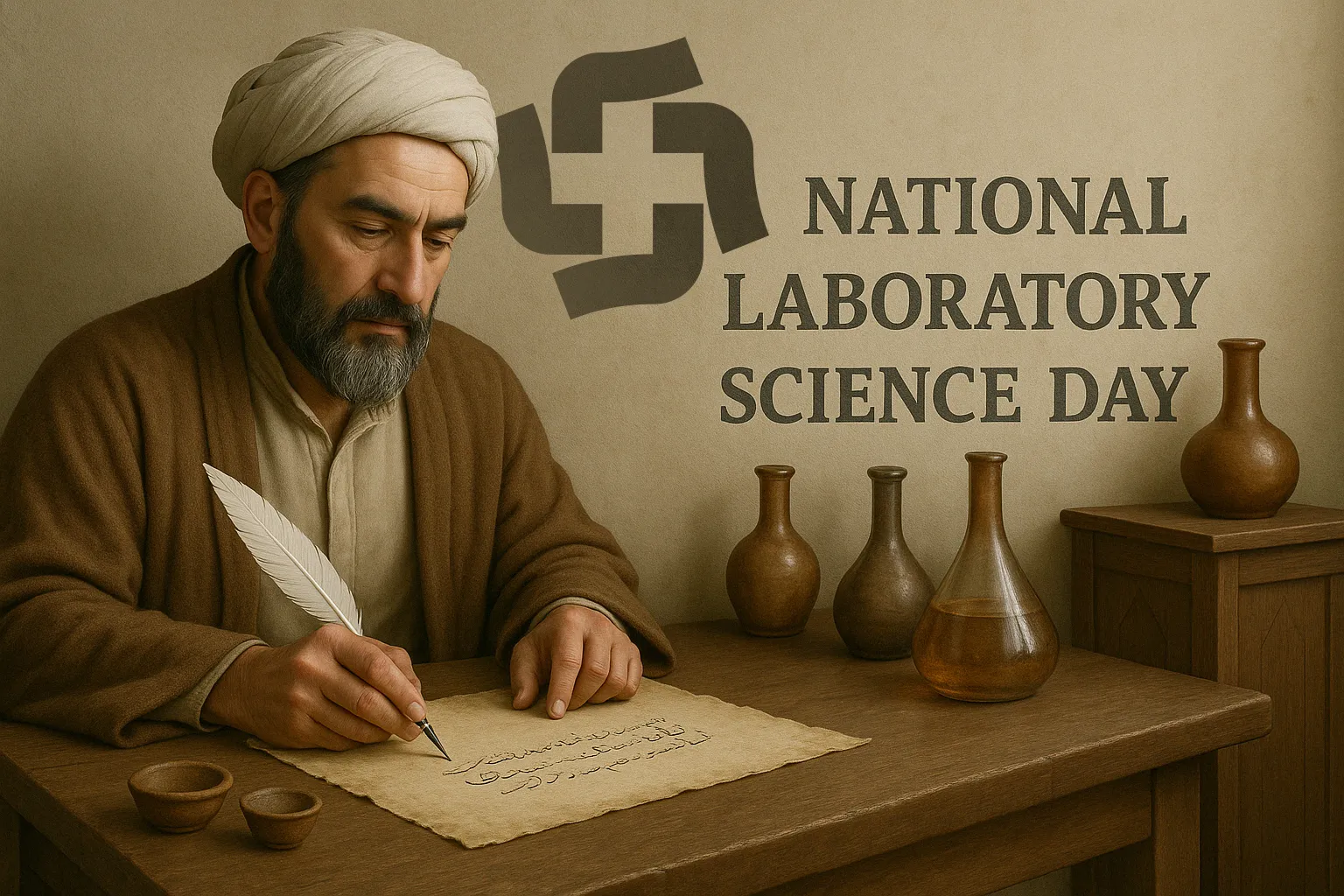
It is a commemoration of the esteemed name of Seyed Esmaeil Jorjani,
the wise Iranian physician, who lit the lamp of knowledge in the darkness of centuries.
In appreciation of your tireless efforts, dear colleagues in laboratory sciences,
who, with every drop of sample, draw closer to the truth,
we congratulate you on this day and acknowledge your steadfastness in the path of
science and humanity.
With hope for a tomorrow where science and ethics advance hand in hand.
Aria Mabna Tashkhis Company
On the occasion of National Laboratory Sciences Day, we are honored to remember one of the most prominent figures in the history of medicine in Iran and the Islamic world, Seyed Esmaeil Jorjani (titled Zain al-Atibba), a physician, scientist, and author who made significant contributions to the development of medical knowledge and laboratory sciences through his enduring works.
Jorjani was born in the fifth century AH (11th century AD) in the Gorgan (Jorjan) region. After years of study, research, and medical practice, he was appointed as the court physician to the Khwarazmian Shahs. He had full command of both Arabic and Persian, but unlike many scholars of that era who wrote their works in Arabic, Jorjani decided to write medical knowledge in Persian so that it would be accessible to the general public and Persian-speaking physicians. This decision was a significant step in indigenizing sciences and transferring knowledge to future generations.
His most important work is “Zakhireh-ye Khwarazmshahi”; a comprehensive medical encyclopedia containing valuable information on anatomy, physiology, diseases, treatments, and even the basic principles of laboratory testing and disease diagnosis. In this book, Jorjani not only addressed disease treatment but also emphasized the importance of prevention, nutrition, personal hygiene, and examining disease signs through meticulous observation of symptoms; concepts that hold immense importance in modern laboratory sciences and medicine today.
A notable point in Jorjani’s thought was his scientific and empirical approach to medical knowledge. He viewed disease as an observable, analyzable, and treatable phenomenon, not merely a philosophical or metaphysical subject. This perspective paved the way for the approach we encounter today in laboratory sciences: data analysis, precise experiments, and scientific decision-making based on evidence.
On National Laboratory Sciences Day, we honor the memory and name of this esteemed physician who, centuries ago, laid the foundations for the scientific understanding of the human body and disease treatment with precision, knowledge, and a love for humanity. The services of Seyed Esmaeil Jorjani belong not only to the past but also serve as an inspiration for present and future generations in advancing science and public health.