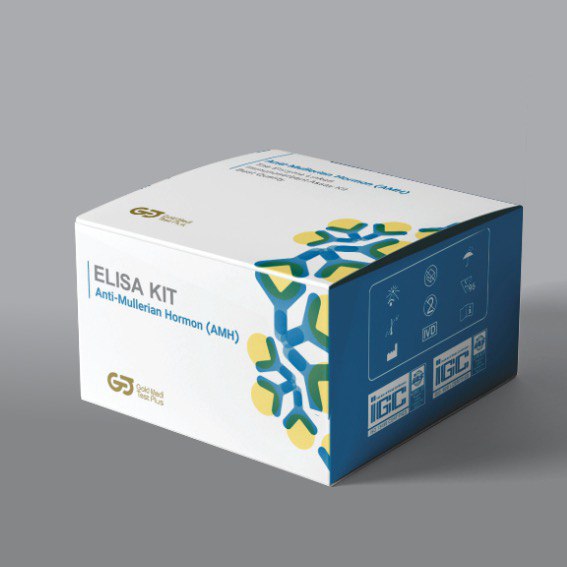
The quantitative AMH hormone detection kit is an advanced diagnostic tool designed for the quantitative measurement of Anti-Müllerian Hormone (AMH) in human serum or plasma using the ELISA method. This kit, with high accuracy and sensitivity, is used for evaluating reproductive health and ovarian reserves in women, and for assessing the function of reproductive organs.
AMH is secreted by growing ovarian follicles and is a suitable indicator for assessing the number and quality of oocytes. Unlike FSH and estradiol, AMH levels are constant throughout the menstrual cycle and can be measured at any time. This hormone is not affected by gonadotropins and solely reflects follicular reserve. AMH measurement is particularly useful in women at risk of reduced ovarian reserve, such as those with Polycystic Ovary Syndrome, a family history of premature menopause, severe endometriosis, or chemotherapy treatments.
Applications of the Quantitative AMH Hormone Detection Kit
The AMH kit is used for evaluating fertility, diagnosing premature ovarian failure, polycystic ovary syndrome, and assessing the effectiveness of fertility treatments. It is also used to evaluate follicular reserves and investigate clinical conditions related to reduced ovarian reserves.
How to Use the Quantitative AMH Hormone Detection Kit
- Allocate two wells for controls, seven wells for standards, and wells for the number of patients. Place any extra wells in a bag with desiccant. (Run standards in duplicate.)
- Pipette 100 microliters of samples, controls, and standards into the wells. Use a separate pipette tip for each.
- Cover the plate and incubate for 60 minutes at room temperature (20-25°C).
- Wash the wells 5 times with 300-350 microliters of wash solution. Let the solution remain for 20-40 seconds each time. Then dry the wells.
- Add 100 microliters of biotinylated antibody solution to the wells and gently shake the plate for 30 seconds.
- Cover the plate and incubate for 30 minutes at room temperature.
- Wash the wells similarly to step 4.
- Add 100 microliters of HRP-streptavidin solution and gently shake the plate for 30 seconds.
- Cover the plate and incubate for 15 minutes at room temperature.
- Repeat washing according to step 4.
- Add 100 microliters of TMB chromogen solution to the wells.
- Keep the plate at room temperature, away from light, for 15 minutes until a blue color develops.
- Add 50 microliters of stop solution and mix gently. The blue color will turn yellow.
- Measure the optical absorbance at 450 nm with a reference of 630 nm, within 10 minutes after stopping the reaction.
Expected Values
Due to biological differences between various populations, as well as factors such as age, gender, race, and geographical factors, it is recommended that each laboratory establish its own normal reference range:
Age Group | Mean (ng/mL) | 5th to 95th Percentile (ng/mL)
—|—|—
Males >12 yrs | 5.7 | 0.7 – 19
Boys 24 months to 12 yrs | 60 | 7.4 – 243
Women 13 to 25 yrs | 4.9 | 0.85 – 13.0
Women 26 to 30 yrs | 4.07 | 0.1 – 8.5
Women 31 to 35 yrs | 3.12 | 0.1 – 7.0
Women 36 to 40 yrs | 1.81 | 0.09 – 6.1
Women 41 to 45 yrs | 0.72 | 0.05 – 3.9
Girls 24 months to 12 yrs | 1.3 | < 8.9
Girls under 24 months | – | < 4.7
Women with reduced ovarian reserve | – | < 1.0
Menopausal women | – | < 0.5
| AMH Level (ng/mL) |
Interpretation |
| Less than 0.36 |
Low ovarian reserve (POF) |
| 0.36 – 0.69 |
Borderline low ovarian reserve |
| 0.69 – 3.8 |
Normal range for ovarian reserve |
| 3.8 – 8.9 |
High ovarian reserve |
Sensitivity:
The minimum measurable concentration of AMH that can be distinguished from a sample without analyte is called sensitivity. This value, calculated based on the mean concentration of the zero standard plus two times the standard deviation (obtained from 10 tests), is 0.03 ng/ml.