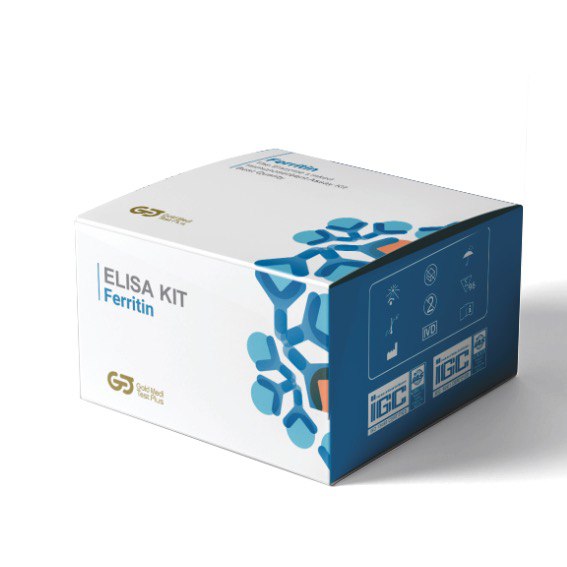
Ferritin Gold Medi Test Plus ELISA kit is designed for the quantitative measurement of Ferritin in serum or plasma samples. This kit uses a sandwich immunoenzymatic method to detect Ferritin with high accuracy and sensitivity. This tool is intended for In Vitro diagnostic laboratories and utilizes pre-prepared reagents for various stages of the test.
Applications of the Ferritin Quantitative Kit in Serum or Plasma
Ferritin, as an iron-storage protein, is an important indicator in assessing the body’s iron status. This kit is used for the diagnosis of iron deficiency anemia, chronic diseases, inflammations, hemochromatosis, and monitoring related treatments. Ferritin levels are also required in special cases such as pregnancy, dialysis, and evaluation of blood donors.
How to Use the Ferritin Quantitative Kit in Serum or Plasma
- Allocate two wells for control, several wells for standards, and wells for the number of patients; store the rest in a bag with desiccant. (Standards should be run in duplicate.)
- Pipette 20 microliters of sample, control, and standard into the wells; use a separate sampler for each.
- Add 200 microliters of HRP to all wells and gently shake the plate for 30 seconds.
- Cover the plate with a seal and incubate at room temperature for 45 minutes.
- Wash the wells 5 times with the special washing solution and dry the moisture at the end.
- Add 100 microliters of chromogen solution to all wells.
- Place the plate at room temperature, away from light, for 15 minutes until a blue color appears.
- Add 100 microliters of stop solution and mix gently until the color turns yellow.
- Within 10 minutes, measure the optical absorbance at 450 nm with a reference of 630 nm.
Normal Values
Generally, a ferritin concentration less than 10 ng/mL is considered an alert level for iron deficiency anemia. For assessing iron overload, the alert levels for men and women are above 400 ng/mL and 200 ng/mL, respectively. The normal ranges of Ferritin in the serum of healthy individuals obtained by repeated ELISA tests are as follows, but it is recommended that each laboratory establish its own reference range:
Normal Range (ng/mL)
Gender
4.5-158.5 Pre-menopausal women
16.5-205 Post-menopausal women
18-242.5 Men
The measurable range of Ferritin concentration with this kit is 2-1000 ng/mL.